
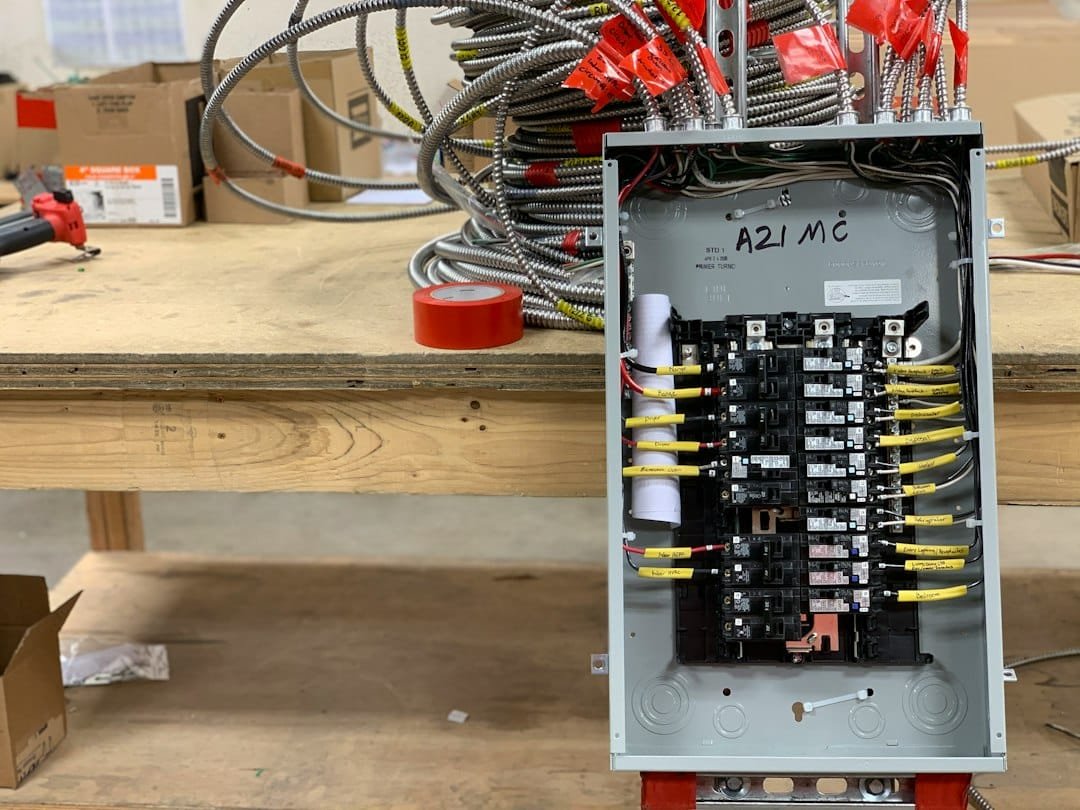
Quick answer: a smart electrical panel can add circuit-level monitoring, app-based circuit control, backup prioritization and, in some systems, automatic load management. But those functions are not the same thing.
A panel that can show circuit energy use does not automatically provide backup power. A panel that can turn a circuit off in software does not replace the physical breaker for electrical service work. And a load-management system can sometimes help a home add large electrical loads without an immediate service upgrade, but only when the equipment, design and local rules support that approach.
Editorial scope: this guide is research-based. WesternTechy reviewed current SPAN, Schneider Electric and U.S. Department of Energy documentation. It does not claim hands-on testing of the products mentioned and does not provide panel-installation instructions.
Start by separating four different jobs
“Smart panel” is a broad label. The useful question is what the system actually does.
- Monitoring: measure whole-home or circuit-level power and energy.
- Control: let an approved circuit or load be turned on or off through the system.
- Backup management: decide which circuits stay powered when the home is running from a compatible battery or other backup source.
- Load management: temporarily reduce or pause selected loads so the home stays within a power or service-capacity limit.
Some products combine all four. Others provide only monitoring, or monitoring plus selected control.
A smart panel is more than an energy monitor
A panel energy monitor measures electrical use. It may tell you the home’s total load or the consumption of selected circuits.
A smart electrical panel can go further by integrating controllable relays or circuit-level control into the electrical distribution system.
SPAN’s current homeowner documentation, for example, describes circuit-level energy monitoring, circuit control, backup priorities and load management. Schneider Electric’s current residential offerings include full smart-panel products as well as modular control relays that can add selected circuit control to compatible panel systems.
That distinction matters because you may not need a full panel replacement just to see energy data.
If monitoring is the only goal, start with Whole-Home vs Circuit-Level Energy Monitoring before assuming a smart panel is necessary.
Monitoring tells you what happened; control lets the system act on it
Circuit monitoring can show that the EV charger is drawing heavily, the water heater is cycling or the dryer is running.
Circuit control adds the ability to change the state of selected loads through the panel’s approved control hardware.
That can be useful for:
- temporarily pausing flexible loads
- reducing demand during a constrained period
- prioritizing circuits during battery backup
- coordinating EV charging with other large loads
- keeping the home below a configured load-management limit
It is not appropriate to assume every circuit should be remotely controllable. Some loads should remain continuously powered, and some equipment has its own required shutdown or control procedure.
Software “off” is not an electrical service disconnect
This is one of the most important boundaries.
SPAN’s current app documentation explicitly warns that turning a circuit off through software should not be treated as a suitable off position for routine service or maintenance. It directs users to switch the corresponding circuit breaker physically off for that purpose.
That is a good general rule for connected electrical equipment.
An app can be part of normal operation. It is not a substitute for the isolation procedure required by the equipment, electrical code or qualified person performing the work.
A smart panel does not create backup power by itself
Backup management and backup generation are different things.
A smart panel can decide which circuits are priorities during an outage, but something still has to supply the electricity.
SPAN states that a panel without a compatible battery or other supported backup source behaves like an ordinary panel during a grid outage: the circuits lose power until grid power returns.
That means a smart panel by itself does not turn rooftop solar into outage power either. Solar-only systems commonly shut down during a grid outage unless the system is specifically designed for off-grid or backup operation.
Think of the panel as the traffic manager, not the power plant.
Backup priorities can make a battery last longer
Where a compatible battery system is integrated, circuit-level control can make backup power more useful.
Instead of backing up every circuit until the battery is exhausted, the system can prioritize loads.
A household might classify circuits conceptually as:
- must have: refrigeration, essential lighting, required medical or communication equipment where supported by the backup design
- nice to have: selected outlets, entertainment or comfort loads
- non-essential during outage: large flexible loads such as some EV charging, pool equipment or other high-consumption circuits
The exact priority scheme depends on the panel and battery system.
SPAN’s current backup-priority tools, for example, let supported installations assign circuit priorities so less important loads can be dropped before the battery is depleted.
Automatic load shedding protects a limited power source
A battery or generator has a maximum power output. If the home tries to draw more than that source can provide, the backup system can overload or shut down.
Automatic load management can reduce the load before that happens.
SPAN’s current backup-overload protection documentation describes temporarily managing selected loads when household demand approaches the configured battery-output limit, then restoring loads when sufficient capacity becomes available.
This is not the same as permanently turning those circuits off. It is dynamic power management based on available capacity.
Load management can also matter while the grid is available
Home electrification adds large loads such as EV charging, electric water heating, induction cooking, heat pumps and battery systems.
In some homes, the theoretical total of those loads can exceed what the existing service should supply simultaneously.
A designed load-management system can prevent selected flexible loads from operating at the same time.
Schneider Electric’s current Smart Power Manager, for example, is designed to shed controllable loads when necessary to keep the home below a configured capacity limit. Schneider positions this as one way some projects can add larger electrical loads without automatically increasing the service size.
That does not mean a smart panel universally replaces a service upgrade.
Whether load management is permitted and appropriate depends on the service, equipment ratings, calculation method, local electrical rules, inspector requirements and the actual loads being added.
Service capacity and energy use are different problems
A home can use relatively little energy over a month and still have a capacity problem.
Energy is measured over time, usually in kilowatt-hours. Service capacity is about how much power the electrical system must be able to supply at a given moment.
For example, an EV charger, electric dryer and electric range could create a high simultaneous load even if each runs only a few hours a week.
That is why reducing annual kWh does not automatically solve a panel-capacity problem.
Load management focuses on coincidence: which large loads can operate at the same time.
A full smart-panel replacement is not the only architecture
There are at least three broad approaches.
| Architecture | What it adds | Typical reason to choose it |
|---|---|---|
| Energy monitor added to existing panel | Whole-home or inferred energy visibility | You want data but not circuit control. |
| Modular circuit-control hardware added to compatible panel | Selected controllable loads plus monitoring | You need control on a few circuits without replacing the whole distribution panel. |
| Integrated smart electrical panel | Monitoring, circuit control, backup priorities and broader energy-system integration | New construction, major electrification, solar/storage project or panel replacement. |
Schneider Electric currently offers examples of both the integrated and modular approaches. Its Energy Center and Pulse products are full smart-panel architectures, while its control-relay approach is designed to add selected smart-panel functionality to compatible existing systems.
New construction and retrofit have different economics
A smart panel is easier to justify when the electrical panel already needs replacement or the home is undergoing a major electrification project.
Examples include:
- new construction
- service or panel replacement
- large solar and battery installation
- major EV-charging upgrade
- whole-home electrification renovation
If the existing panel is healthy and the only goal is energy visibility, a separate monitor may be far less disruptive.
Do not replace a serviceable panel solely because an app interface looks more modern without first defining the actual benefit.
Smart panels can help coordinate solar, batteries and EV charging
The value of circuit control grows as more energy systems interact.
Schneider’s current home-energy platform, for example, is designed to coordinate solar, battery storage, EV charging and controllable household loads through one system.
SPAN similarly integrates panel data with supported solar, storage and EV equipment.
The point is not that one ecosystem is universally best. It is that energy-system integration can reduce the number of independent control layers when the products are intentionally designed to work together.
Before choosing a panel, verify the exact battery, inverter, EV charger and generator integrations you expect to use.
Generator integration needs product-specific checking
Do not assume a smart panel’s battery-backup features work the same way with a standby generator.
SPAN currently supports some generator installations when the panel is placed downstream of an appropriate transfer switch, but its documentation notes limitations compared with supported battery integration. In that configuration, automatic battery-style load shedding and backup-runtime features may not apply.
Generator, transfer equipment and panel design should be treated as one electrical project.
Internet loss should not make the electrical system unusable
A connected panel still needs a sensible failure mode.
SPAN’s current connectivity documentation says the panel continues operating according to its most recent settings when internet connectivity is temporarily lost, and it also provides a local on-premise access path for certain functions.
That is the kind of question worth asking of any smart panel:
- what continues to work without the internet?
- can circuits still be controlled locally?
- what happens to backup priorities?
- does energy monitoring continue or only upload later?
- what happens if the home router circuit is accidentally turned off?
A home’s electrical distribution should not become mysterious because a cloud service is unavailable.
Do not put every circuit under automatic control
A controllable circuit should have a reason to be controllable.
Strong candidates can include flexible loads whose temporary interruption is acceptable and supported by the equipment.
Poor candidates include circuits where unexpected interruption could create a safety, security, health or property problem.
Examples that deserve extra scrutiny include:
- medical equipment
- alarm and communication systems
- sump pumps
- refrigeration where food safety is at stake
- equipment with a required shutdown process
- loads that should not restart automatically after power restoration
Backup priority and controllability should be reviewed deliberately with the installer.
Load shedding and time-of-use optimization are different goals
Load shedding may exist to keep the home under a hard power limit. Time-of-use optimization exists to shift electricity use into a cheaper period.
A circuit can be flexible enough for one purpose but not the other.
For example, an EV charger might be scheduled overnight for a cheaper tariff and also temporarily reduced when another large load needs capacity.
Those are two separate control rules.
See Time-of-Use Electricity and Smart Homes for tariff-based scheduling.
Smart panels and utility demand response are not automatically the same thing
A panel may be capable of managing loads, but that does not mean the utility can control those loads.
Utility participation depends on the program, enrolled device, permissions and local tariff.
Keep local load management, household automation and utility demand-response enrollment conceptually separate.
What to ask an installer before choosing a smart panel
| Question | Why it matters |
|---|---|
| What problem are we solving? | Monitoring, panel replacement, backup, electrification and load management can require different hardware. |
| Which circuits can be controlled? | Not every load should be remotely interruptible. |
| What happens without internet access? | Determines local-control and recovery behavior. |
| Which batteries, inverters and EV chargers are supported? | Integration is product-specific. |
| How does generator backup work? | Generator behavior can differ from battery integration. |
| Can load management affect service-upgrade requirements? | Needs project-specific electrical calculations and local approval. |
| What data is stored and where? | Energy history and cloud dependence differ by ecosystem. |
| How is the panel serviced if the smart electronics fail? | The electrical distribution system should remain maintainable over its service life. |
| Which functions remain if the vendor service changes? | A panel is a much longer-lived asset than a phone app. |
A smart panel should still be an electrical panel first
Connected features are valuable only if the underlying electrical system remains safe, serviceable and understandable.
That means:
- proper overcurrent protection
- clear circuit identification
- qualified installation
- physical breaker operation
- documented backup architecture
- a recovery path if connectivity fails
The app is an additional control layer. It should not become the only way to understand or safely maintain the system.
When a smart panel is probably overkill
You may not need a smart panel if:
- you only want to monitor a few plug-in devices
- you only want whole-home energy data
- the existing panel does not need replacement
- you have no backup, EV or major electrification plans
- you do not need circuit-level control
In those cases, a smart plug, energy monitor or a smaller modular solution may solve the actual problem for less cost and disruption.
When a smart panel can make sense
It becomes more compelling when several of these are true:
- the panel already needs replacement
- solar and battery storage are being added
- the home needs backup-load prioritization
- EV charging is part of a broader electrification project
- large flexible loads need coordinated management
- circuit-level energy data is useful
- the homeowner values integrated control over separate systems
The more of those needs exist at the same time, the easier it is to justify the complexity.
Related WesternTechy guides and tools
- Smart Home Energy & Cost hub
- Whole-Home vs Circuit-Level Energy Monitoring
- Time-of-Use Electricity and Smart Homes
- How to Measure Smart Home Energy Use Safely
- Smart Home Planning Checklist & Worksheet
- Smart Home Cost & Budget Calculator
Sources and editorial method
WesternTechy used current manufacturer and government documentation to verify the panel, circuit-control and load-management concepts described here.
- SPAN: Panel System Designs & Specifications
- SPAN: Home App and Circuit Control
- SPAN: Backup Overload Protection
- SPAN: Panel Connectivity
- Schneider Electric: Square D Energy Center
- Schneider Electric: Modular Smart Panel Functionality
- Schneider Electric: Smart Power Manager
- U.S. Department of Energy: Smart Electrical Panel-Based Home Energy Management System
Smart-panel capabilities change quickly and electrical requirements vary by jurisdiction. Verify the exact panel, connected energy systems and current installation documentation with a qualified electrician before purchase or installation.