
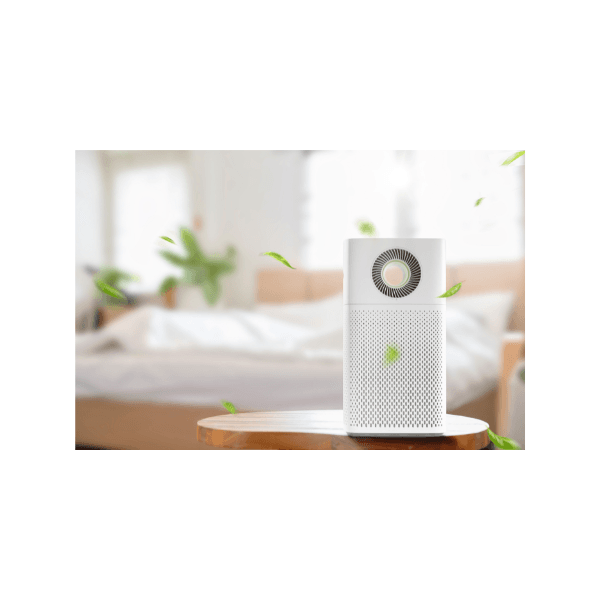
A smart air purifier can report a reassuring green air-quality score while running too slowly for its room. Another model may be loud but move enough filtered air to make a meaningful difference. For renters and homeowners, the practical question is not whether the purifier has Wi-Fi. It is whether it can filter the particles you care about, in the room where people actually spend time, for enough hours at a usable fan speed.
Quick answer: measure the room, compare a published smoke/PM2.5 clean air delivery rate (CADR) against room area, favor proven mechanical particle filtration, leave clear space around the air intake and outlet, and check replacement-filter availability. Smart scheduling can improve convenience, but the filtration performance and a usable manual control matter more than the app. An air cleaner does not replace source control, appropriate ventilation, mold remediation or a certified carbon-monoxide alarm.
Editorial scope: This US-first Guide is for portable residential air cleaners, primarily in one room. It is not a medical treatment guide, commercial HVAC design, whole-building ventilation plan, or tested-model ranking. Recommendations are based on public EPA, ENERGY STAR and California Air Resources Board (CARB) guidance checked October 22, 2026, not hands-on tests of every purifier. The featured photo is illustrative and does not establish a tested or endorsed device.
Begin with the pollutant and its source, not the app
| Your concern | What the purifier can reasonably help with | What still requires another response |
|---|---|---|
| Cooking smoke and indoor particles | Suitable particle filtration can reduce airborne particles after emissions enter the room. | Use an appropriate kitchen range hood/exhaust when safe; address the cooking source and ventilation. |
| Outdoor wildfire smoke entering a room | A well-sized, continuously operated particle air cleaner can reduce particle concentrations in a cleaner-air room. | Follow official wildfire and local air-quality guidance on windows, ventilation and outdoor exposure. |
| Pollen and household dust | An appropriately filtered, sized and used device can remove some airborne particles. | Housekeeping, source control and reducing the introduction of pollutants remain necessary. |
| Chemical odors and gases/VOCs | A separately designed substantial sorbent/activated-carbon filter may help with certain gases. | Standard particle CADR is not a gas-removal score; fix emission sources and use ventilation where appropriate. |
| Persistent dampness or mold | It may capture some airborne particles and possibly some odors, depending on filtration. | Find and correct the moisture source. A purifier does not repair leaks, water damage or mold growth. |
| Stuffy room / high CO2 reading | Mechanical particulate filters do not reliably remove CO2 or supply fresh outdoor air. | Assess occupancy, outdoor-air ventilation and the underlying cause of poor air exchange. |
| Carbon monoxide, smoke or fire alarm | A consumer air purifier must not be relied on as a hazard detector. | Maintain code-compliant, working smoke and CO alarms and appropriate emergency responses. |
EPA identifies source control, ventilation and supplemental filtration as complementary ways to improve indoor air quality, not interchangeable fixes. Its Guide to Air Cleaners in the Home explains that most air cleaners are designed for particles or gases and that no purifier removes all contaminants. Our Humidity & Air Quality Sensors Guide explains how to interpret PM2.5, VOC, humidity and CO2 readings before automating a response.
CADR is the number that should set the room-size decision
CADR measures the delivery rate of cleaned air, commonly in cubic feet per minute (cfm) in the US. It is not simply the fan’s free-airflow rating. For particles, higher CADR generally means greater cleaning capability at the tested conditions. A verified smoke CADR is particularly useful when selecting for fine particulate pollution. If a listing quotes only “up to 2,000 sq ft” without the test method, fan speed or smoke CADR, request the actual performance data rather than treating the marketing area as directly comparable.
ENERGY STAR’s air-cleaner room-sizing table uses a conservative selection estimate of about 0.65 cfm of particle CADR per square foot for a typical 8-foot ceiling. EPA’s cleaner-air-room guidance describes selecting a smoke CADR of at least roughly two-thirds of room area, also with attention to ongoing operation. These are useful selection rules, not field measurements, a guarantee of a specific air-change rate, or claims about real-world health outcomes.
| Room area | Minimum estimated smoke/particle CADR | What to check |
|---|---|---|
| 100 sq ft | About 65 cfm | A small bedroom or office; confirm speed/noise at the useful setting. |
| 150 sq ft | About 100 cfm | Measure the real room, not just the floor area beside the purifier. |
| 200 sq ft | About 130 cfm | Compare against the exact model’s published smoke CADR. |
| 300 sq ft | About 195 cfm | Check whether the space opens to a hall or adjacent room. |
| 400 sq ft | About 260 cfm | A larger room may need a bigger unit or properly distributed units. |
| 500 sq ft | About 325 cfm | Expect higher fan noise and power consumption at useful filtration settings. |
Worked example: a 12 × 15 ft bedroom has an area of 180 sq ft. Applying 0.65 × 180 gives an illustrative selection target of about 117 cfm smoke CADR at standard 8-foot ceiling assumptions. A unit rated at 65 cfm would be substantially below that reference. A 140-cfm model would exceed the rule-of-thumb target on the rating basis, although real performance still depends on placement, filter condition and operating speed.
The EPA and ENERGY STAR warn that rooms with ceilings higher than 8 feet may need a higher rating; an open floor plan should be evaluated as the larger connected space that the air cleaner serves. Do not assume that a small unit can clean an entire multi-room apartment because a listing displays a giant square-foot figure. If needed, choose separate properly positioned units for the areas where occupants spend time.
How to evaluate a purifier without falling for misleading labels
| Specification | Useful interpretation | What not to infer |
|---|---|---|
| Smoke / PM2.5 CADR | A standardized figure for the rate of delivery of particle-cleaned air. | Does not directly measure VOC, odor, CO2, virus elimination or a medical outcome. |
| Filter and media design | Mechanical particle filtration (often HEPA-based) for particles; substantial carbon/sorbent media for targeted gases. | An incidental thin carbon pre-filter does not establish broad VOC removal. |
| AHAM Verifide / independent listing | Useful third-party confirmation of supported CADR claims for a listed model. | A logo is not proof that every brand variant or marketing feature has been independently tested. |
| CARB listing | California’s certified device list addresses electrical safety and specified ozone-emission requirements. | CARB explicitly does not certify a model’s pollutant-removal effectiveness or overall health safety. |
| ENERGY STAR | Measures qualifying energy efficiency, including an air-cleaning-to-power performance requirement. | It is not EPA endorsement of a claimed health benefit or a substitute for adequate CADR. |
| Replacement filter part and cost | Shows whether the correct filter is obtainable and how routine maintenance will work. | “Washable prefilter” does not mean every main HEPA/sorbent filter can be washed or reused. |
Before purchasing, use the product’s exact model and filter part number. The California CARB certified-device list is a way to check regulatory listing status, but CARB stresses that certification alone does not establish cleaning effectiveness. ENERGY STAR’s current key criteria concern standardized particle CADR and energy efficiency. Compare both alongside the correct model’s filter documentation, not as competing “best purifier” awards.
Mechanical filtration, carbon filters and ozone safety
For ordinary household particle removal, EPA describes high-efficiency mechanical filtration as a common approach and says portable purifiers often use HEPA filters to deliver high CADR. To address gases, EPA points to activated-carbon or other sorbent media that are specifically designed for those contaminants; capacity and amount of material matter. A standard particle CADR test does not prove removal of formaldehyde or a broad group of VOCs. If a seller claims “removes all gases,” ask for credible contaminant-specific testing instead of relying on marketing language.
Avoid appliances that intentionally generate ozone. EPA identifies ozone as a lung irritant and warns that some ionizing, plasma, electrostatic or UV-associated cleaning technologies can generate ozone under some circumstances. CARB’s listing distinguishes mechanical from electronic models and its low-emission limit is not a blanket guarantee of zero ozone. Do not assume “ionization” is a necessary feature just because the device is described as smart. EPA air-cleaner guidance; CARB consumer guidance.
Placement and fan speed decide whether the rated performance reaches the room
- Keep the airflow path open: follow the maker’s minimum clearance around intakes and outlets; don’t hide the unit behind a sofa, thick curtain or door.
- Use the room where exposure matters: bedrooms, living rooms or a designated cleaner-air room often make more sense than an unused hallway.
- Respect doors and connected spaces: closing a door changes the volume served; an open-plan room requires sizing for the larger actual area.
- Run it at a useful speed for enough hours: published CADR is commonly rated at a higher fan setting. Quiet/sleep mode usually moves less filtered air.
- Prepare for maintenance: leave practical access to the filter cover, avoid forcing cords under doors and do not place the unit where a child or pet can easily topple it.
- Preserve appropriate ventilation: an air cleaner filters recirculated air; it does not bring in outside air or replace a needed exhaust fan.
EPA and ENERGY STAR both advise unobstructed placement and note that higher fan speeds and longer run times increase filtration. For a wildfire smoke event, EPA cleaner-air-room instructions advise preparing a designated room and running appropriately sized filtration continuously at the highest setting during the event, alongside the applicable window/ventilation measures. Do not extrapolate that advice into closing all ventilation permanently in a normal household; follow current outdoor-air conditions and public-health guidance.
What should the smart features actually do?
A useful connected purifier should remain a capable stand-alone air cleaner. An app is optional convenience, not a substitute for CADR, maintenance or manual operation. Consider these features after performance and replacement filters have been checked:
| Feature | Real benefit | Design limit or risk |
|---|---|---|
| Local button and display | Allows speed changes and filter-status checks without internet or a vendor account. | Confirm child lock and power recovery do not block basic operation. |
| Timer / schedule | Can start filtration before a regular occupied period, or prevent accidental all-day high-speed noise. | A schedule must not unintentionally stop necessary filtration during a smoke event. |
| Auto mode from built-in PM sensor | May change fan speed in response to the sensor’s detected particle changes. | Thresholds, sensor accuracy, placement and update intervals vary; it is not a substitute for adequate baseline airflow. |
| Connected PM2.5 monitor | Can help compare before/after patterns and understand cooking or outdoor infiltration events. | A single reading does not represent the whole home or prove medical safety. |
| Smart-home integration | Could allow visibility, filter notifications or low-risk scheduled modes. | Confirm exact model, account, cloud and API dependencies before promising local control or cross-platform automation. |
| Filter reminders | May help the household service the device on time. | Manufacturer estimates do not necessarily measure actual filter loading or replacement requirements. |
EPA’s low-cost air-monitor guidance explains why consumer monitors can provide useful trends but not comprehensive measurements of every pollutant; humidity, location and sensor technology can affect readings. A green app indicator does not mean the room is free of carbon monoxide, radon, VOCs or other hazards the sensor cannot detect. The response should be matched to the measured pollutant and the device’s actual capabilities.
Three automation patterns worth considering
Pattern A: maintain a minimum occupied-room fan setting
Set a tolerable baseline fan speed during bedroom occupancy, if the purifier’s instructions support scheduled operation. Prefer a manually understandable fallback when the app, Wi-Fi or cloud is unavailable. If the unit’s quiet mode is too weak for the measured space, consider a better-sized purifier rather than describing that weak mode as equivalent filtration.
Pattern B: respond to a measured particle event without oscillating
If the manufacturer supports a built-in PM-based auto setting, use it as a convenience feature and observe real behavior across cooking or outdoor-particle events. A custom rule using an external PM sensor should not be implemented until you have verified actual sensor support, sampling behavior and device actions. Avoid rapid fan-speed oscillation by using tested thresholds, a minimum-run window and a safe manual override where supported. Do not invent platform-level features your devices do not expose.
Pattern C: filter reminder and periodic household check
Keep a private log of filter changes, room changes, operating noise and observed airflow. A phone reminder or dashboard notification can help without controlling a critical device. In a shared rental or managed property, document who buys replacement filters and who is allowed to change the appliance settings. Use the Device Inventory & Account Transfer Tracker to record ownership and maintenance responsibility, not any passwords.
Avoid using a generic smart plug as an improvised purifier speed controller or automatically cycling the supply. The purifier manufacturer must permit unattended restoration or external power control, and a smart plug’s electrical rating alone does not prove the appliance will recover safely or preserve settings. For connected automations, keep a direct manual control and use the Automation Planning & Testing Worksheet to test false conditions, power recovery and fallback behavior.
Practical costs: electricity, filters, noise and subscriptions
Total running cost includes purchase price, replacement filters, measured or documented electricity use, and any optional app subscription. To estimate electricity, multiply actual watts × operating hours ÷ 1,000. For instance, an illustrative 30-watt purifier running 8 hours a day for 30 days uses 7.2 kWh; at the same wattage 24 hours daily it uses 21.6 kWh over 30 days. Multiply by your actual electricity tariff to estimate energy expense. These figures are arithmetic examples, not measurements of any named purifier.
Energy demand changes with speed; many purifiers consume less power in sleep mode but also move less filtered air. Check an independent measured wattage figure for the model and fan speed you will actually use. ENERGY STAR qualification can help assess energy efficiency, but it should not override adequate CADR. Our Energy Use Measurement Guide explains safe plug-level monitoring without exceeding electrical ratings.
Room-by-room commissioning checklist
| Check | What to record or test | Decision |
|---|---|---|
| Room sizing | Length × width, ceiling height, open doors/connected space, estimated area. | Adequate / needs larger unit |
| Pollutant targeted | Fine particles, odors/gases, humidity/moisture, CO2, or another issue. | Is filtration an appropriate response? |
| Particle capacity | Published smoke or PM2.5 CADR in cfm; target around 0.65 × sq ft for 8-foot sizing. | Meets estimate / unverified |
| Filter service | Exact replacement filter part and readily available replacements. | Known / unavailable |
| Position | Intakes/outlets clear, no tripping hazard, acceptable fan noise. | Pass / adjust |
| Real operation | Manual speed control, intended auto/schedule behavior and loss-of-Wi-Fi fallback. | Pass / issue |
| Ozone and labeling | Check exact model against CARB list where applicable; avoid intentional ozone generation. | Checked / unverified |
| Maintenance | Filter inspection and replacement instructions, owner, service date. | Recorded / missing |
This checklist helps you make a transparent selection; it is not a safety certification or proof of achieved particle concentration. If you need a more systematic seven-day sensor log, our Humidity & Air Quality Sensors Guide owns that measurement methodology. This Guide owns purifier sizing and use, while product-by-product comparisons belong in Buying & Reviews after verified model research.
Renter, family and landlord considerations
- Renters: a plug-in purifier is generally easier to move than a permanent whole-home filtration change; check lease/property rules and avoid altering shared ducts, vents or electrical circuits.
- Homeowners: when considering MERV 13 or higher HVAC filters, ensure the system can accommodate the filter without undue airflow restriction; consult the HVAC maker or a qualified technician where needed.
- Landlords/property managers: clarify who maintains and pays for filters, who owns the appliance and whether air-quality reporting collects private household information.
- Children, older adults and accessibility needs: prioritize stable placement, understandable manual controls, tolerable noise and unobstructed circulation paths. Avoid promising medical results from a manufacturer’s app score.
- Life safety: maintain functional smoke/CO alarms and address water leaks, combustion sources, gas emergencies, and mold independently of any purifier’s operation.
A high-efficiency central HVAC filter may reduce particles throughout a home, but it is not a drop-in upgrade for every furnace or air handler. EPA advises using a MERV 13 filter or the highest efficiency the system can accommodate, and consulting qualified expertise when necessary. See EPA’s HVAC and portable air-cleaner comparison. Do not tamper with building-managed ventilation to install a smart accessory.
Common buying and setup mistakes
| Mistake | Why it matters | Better decision |
|---|---|---|
| Trusting a huge advertised room size without CADR | Coverage claims can use different time assumptions and may be unsuitable for the intended setting. | Compare published smoke/PM2.5 CADR, actual room area, operating speed and ceiling height. |
| Using ‘air quality score’ as a general safety guarantee | Low-cost sensors monitor selected contaminants only and may be affected by placement and humidity. | Use readings for trends and retain independent safety alarms and source-control measures. |
| Assuming a purifier removes CO2 and moisture | Particle filters recirculate/filter air and do not add outside air or repair water damage. | Use appropriate ventilation and moisture remediation. |
| Ignoring noise at a useful speed | A unit run only at very low airflow may not deliver the expected practical filtration. | Evaluate noise and CADR at operating settings people will actually tolerate. |
| Confusing CARB, ENERGY STAR and CADR | They address different aspects of a product. | Check ozone-regulatory listing, energy efficiency and particle-delivery capability independently. |
| Buying a cloud-dependent ‘smart’ model first | The app or service can become unavailable, while the manual purifier still needs to work. | Prioritize stand-alone fan control, replaceable filters and documented local behavior. |
Sources and editorial method
Source review: October 22, 2026. Primary public references: EPA — Guide to Air Cleaners in the Home; ENERGY STAR — Air Cleaners; ENERGY STAR — Key Product Criteria; EPA — Low-Cost Air Monitors; EPA — Cleaner Air Room; CARB — Air-Cleaner Consumer Information; CARB — Certified Air-Cleaner List. The room-size table follows published EPA/ENERGY STAR estimates for approximately 8-foot ceilings; the scenarios, checklists and automation cautions are WesternTechy editorial synthesis. We did not directly measure purifier CADR, ozone emissions, sensor accuracy or clinical outcomes. Verify models and current manufacturer instructions before buying or changing the way equipment operates.